Tuesday, April 12, 2011

BIG NIGHT DINNER – THE PREP BEGINS

The first steps will be to make the two tomato sauces for the dinner.  The first is based on the recipe suggested in the Tucci and Scappin cookbook for use in the Timpano.  It is basically a ragout of pork and beef that is slow cooked for a long time.  The meat is then removed and the meaty tomato sauce is used in the Timpano.


 The removed meat makes a really good pulled pork/beef sandwich or topping on pasta.


The second sauce to accompany the Porchetta is based on a marinara sauce made with pancetta.


With the two sauces done it’s on to meatballs that will be part of the Timpano.  There must be thousands of recipes for Italian meatballs.  I like a traditional one simply made with pork and beef, bread crumbs, and flavored with fennel seed, garlic, oregano, and parsley.


These are made small and fried before mixing them in the tomato sauce to finish.


Next is the pre-cooking of good Italian sausage.


Genoa salami is diced.


The Timpano also contains hard boiled eggs.  The easiest and best way to accomplish this is to place room temperature eggs in a single layer in a pot, cover by one inch with cold water, bring to a boil, cover and remove from the heat and let stand for 15 minutes for large eggs, then run under cold water until cool.  They can be peeled at that point or stored in their shells in the refrigerator for up to one week.

 Good Italian pasta is cooked al dante and some of the ragout is mixed in.  With this done all of the prep for the Tampano, with the exception of the external dough, is done.

Next is the prep of the Tourte Milanese.

Although many component items can be purchased in stores, some things are better done yourself.  The roasting and peeling of red peppers is one of those things.  First they are charred under the broiler and then immediately placed in plastic bags to steam.  This step allows for the easy removal of the skin.


Once peeled, the peppers are cut and cleaned for the Tourte


The life of a Sous-Chef de Cuisine is never easy.  Here Sous-Chef Louise, shortly after her latest and hopefully last surgery, is de-stemming two pounds of spinach.


The spinach is then sautéed with garlic.


Another ingredient in the Tourte are very loosely scrambled eggs (they will continue cooking when the Tourte is baked) which are flavored with tarragon, chives, and parsley.


Good quality ham and imported Swiss cheese are store bought.


Preparing the Porchetta requires a little butchering skills.  A skin-on pork belly which is basically uncured bacon and a pork loin roast are cleaned.


Slits are made in the meat and lemon zest, garlic, fennel seeds, salt and pepper are rubbed in.


The whole thing is rolled up and tied.


The Porchetta is then wrapped in plastic and then tin foil and is then placed in the refrigerator overnight for the flavors to meld.


The day before the party we made our two desserts.  First was a Tiramisu.  There are many recipes for Tiramisu, but one we think is the best is made from raw egg yolks and whites, and crispy imported Italian lady finger cookies called Savoiardi.


These cookies are dipped in a mixture of espresso and rum, and everything is layered.  This also goes in the refrigerator overnight.

Wednesday, April 6, 2011

BIG NIGHT DINNER – THE PRELUDE

In addition to being totally addicted to good food, Louise and I are also into movies.  Although our tastes in movies generally differ (Louise liking comedies and musicals and I liking action films), they also overlap in many areas as well.  Most importantly, we both love foodie films.  Although we have many in our collection one has always stood out as the best of the best.  “Big Night” which came out in 1996 has an incredible all-star cast, including Tony Shalhoub, Stanley Tucci, Isabella Rossellini, Minnie Driver, Allison Janney, and Ian Holm.  Oh did I mention Isabella Rossellini?  Set in the late 1950s in a coastal town in New Jersey, two brothers come from Italy to open a restaurant.  Despite producing some of the most incredible regional Italian food, those Americans seem only to want meatballs and spaghetti.  In a desperate attempt to keep their restaurant afloat, the two brothers produce the most incredible Italian feast in the hopes that a famous musician and the media will re-vitalize their business.  

Not only is this movie a realistic depiction of the difficulty introducing new and wonderful culinary experiences to unsophisticated palettes, but it is also a metaphor for many experiences in life.  Sometimes someone can put in front of you something new and wonderful but fear of change or fear of the different precludes you from experiencing new opportunities, and as in the case of Big Night, to your own detriment.

Now that the “stage is set,” we decided to invite 15 folks, most of who have not seen the movie, to come watch it at our house.  Of course, it is physically impossible for us to show a movie without also cooking something for our guests to eat.  The movie makes it both easy and difficult to decide on a menu for the dinner.  On the one hand the movie presents multiple wonderful dishes.  On the other, many are complex and time consuming to recreate.  Of all of the dishes featured in this movie the one that is most prominent, and rightly so, is the Timpano.  Describing this dish is not easy.  I think of it as “What would an Italian grandmother do with a massive amount of wonderful leftovers and the need to feed 20 or more people?”

So influential was this movie in foodie circles that in 1999 the cookbook Cucina & Famiglia, authored by Joan Tropiano Tucci and Gianni Scappin, came out.  Not only is there a recipe for a Timpano but it is an all around good Italian cookbook.

With the Timpano as our starting point we devised a buffet style menu to celebrate this movie.  Included are the following:
·        A salad of plum tomatoes and mozzarella, with basil and balsamic vinaigrette.
·        The Timpano
·        A Porchetta
·        A Tourte Milanese
·        Tiramisu
·        Ricotta Chocolate Chip Pie
It is now about a week out from the party so the cooking must begin.  Not being an Italian grandmother I have to start making all of those leftovers to include in the dishes.

Saturday, March 19, 2011

French Almond Cake

We had the great pleasure of being invited to partake in the inauguration of our neighbors Laurie and Paul’s deep fat turkey fryer.  The turkey itself as well as all of the food that everyone brought was great.

Our contribution was a French almond cake whose base comes from a Jacque Pépin recipe.  What makes the cake itself so good is our use of French almond paste in the recipe.  Also nice about this recipe is that it is made in a food processor.


We make this cake in a pan that has an indention in the bottom (top when you turn it over) that can be filled with many different types of fillings such as pastry cream or as in this version ganache.  But I am jumping ahead….


A nicely baked cake, browned on the outside and soft and moist on the inside.


First, to add to the existing almondness (I’m not sure that is a real word) the cake is further moistened in a soaking syrup made with Disaronno Originale, an Italian almond liqueur.


Next, the indentation is filled in with ganache which is made with Valrhona Manjari 64% dark chocolate.  A video of making ganache is in an earlier blog posting.


Once the ganache has set, the top is decorated with cut strawberries.

Finally, the cake is glazed with a neural clear gel which not only keeps the fruit fresh but also gives it a nice shine.


Given the number of expected guests, we made two cakes to be sure that there would be seconds if requested.  Needless to say we all had a great time eating appetizers, turkey, sides, and dessert.

Sunday, March 6, 2011

PSYCHOPHARMACOLOGY

Professionally as a Neuropsychologist I engage in continuing education to keep my skills up to date in many related areas.  This pursuit does require me to leave my kitchen from time to time.  For several years I have attended the Psychopharmacology Update sponsored by the Nevada Psychiatric Association and the University of Nevada School of Medicine.  This is an international conference held in Las Vegas that covers many aspects of psychopathology and its treatment.  This year was a day on Post Traumatic Stress Disorder (PTSD) as well as presentations on child and adolescent Bipolar Disorder, Autism, self-injury, Oppositional Defiant Disorder, and adolescent brain development.  Although I learned a lot about prescription medications, I also had to pursue those that were non-prescription and otherwise readily available.  Oh, and did I mention also legal to possess.

With a little research I found that Las Vegas has as last count thirteen chocolatiers and pastry shops.  Chocolate has been described as one of nature’s most complex and satisfying substances, with many varied health benefits.  Rather than get into the chemistry of chocolate in depth, the Huffington Post article by John Robbins is a great summary of the available knowledge.


Suffice to say that chocolate contains several antioxidants that positively impact cholesterol and blood pressure.  Also in chocolate is theobromine which is a mood enhancer that increases serotonin in the brain, as well as phenethylamine that supports that production of pleasure enhancing endorphins.

Using myself as a test subject, along with my trusty research assistant Louise, we sampled the “medications” dispensed by three of Las Vegas’ finest.  This included lunch and pastries, as well as French macaroons (nothing like those coconut blobs) at Chef Payard’s Patisserie.  Each of the following websites are well worth checking out.


We also visited the wonderfully creative and artistic establishment of Chef Max Brenner.  On his menu are such delights as “Illegal Chocolate Chocolate Chocolate Pancakes.”  I even got the tee-shirt.  I did however forget the camera so pictures will have to wait for our next trip.


Finally, there is Chef Jean Philippe’s shop.  The chocolate fountain is reportedly 27’ tall and employs 2,100 pounds of white, milk, and dark chocolates.  I think that the photos speak for themselves.


When I got home I decided to check my “medicine cabinet.”  Luckily it was well stocked with all that I need to keep my mood in check when facing the challenges of daily life.  French pharmaceuticals are always the best.


Sunday, February 13, 2011

Louise’s Birthday

Over the years we all develop traditions around special occasions, and we are no different.  Since Louise’s birthday typically occurs around football playoff time and given that it was started in Chicago in January where it is not uncommon to have negative number wind chills, her choices represented hunkering down comfort food.

Given that the playoffs are an all day affair her selections include “breakfast,” something to munch on during the games, and “dinner.”

This “breakfast” again reflects the Murphy’s Law that states “That which takes the longest to prepare, takes the shortest to eat.”  In this case, Nancy Silverton’s recipe for “Pecan Sticky Buns” in the book Baking with Julia by Dorie Greenspan. 

For this recipe you have to first make Brioche, which if you are not familiar, is a wonderfully buttery and eggy French bread.  For this very flavorful version you first make a sponge, then prepare the dough which incorporates six ounces of butter, and have it go through two separate risings.  Twenty-our hours later you now have the dough needed to begin to prepare the sticky buns.  A good part of a day is needed for this second phase before baking can occur.

When the dough is ready it is rolled out, covered with sugar, nuts, and butter, then re-rolled.  The dough is then sliced to make the individual buns.  Nuts are placed on top of each and then they are placed in a pan with butter and brown sugar and allowed to proof.


Once baked they are turned out and eaten as soon as they cool a little.


Now like any tradition, aspects of the ritual are open for change.  After approximately 10 years of this one, Louise announced this morning “I’d like bacon with this next year.”  I guess that throughout history such epiphanies have resulted in great alterations in life.


The afternoon munchie is Louise’s own creation – clam dip.  Clams, cream cheese, and seasonings.  With some good salty chips, this dish gives you all of the energy you need to maintain a constant level of yelling at the TV.


Finally, there is “dinner.”  Some people can eat breakfast for lunch or dinner.  Given the meat in this dish, it appears to be not unreasonable to do so.  Therefore, corned beef hash with a softly fried egg on top make up the final meal of the day.


Onion, red and green pepper, potatoes, and corn beef are sautéed.


Everything is plated and topped with two eggs.


Did I mention the left over pecan sticky buns from breakfast?


Sunday, January 23, 2011

A FIVE-COURSE FRENCH MEAL WITH FRIENDS


We have friends over regularly for meals that we cook.  Some are very casual and usually center around one main dish with an appetizer and dessert.  But those that are typically the most enjoyable to us are the five-course French dinners.  The feeling that comes from seeing the days of preparation culminate in a group of adults quietly slouching in their chairs emitting quiet groans is hard to describe.

Here is our menu for this January evening.  We produce menus for these meals in order to keep track of what we have served specific guests (so as not to repeat a dish unless requested).  In addition, some of our guests seem to like to take the menus home.


DINNER AT RU AND LOU’S

SUNDAY, JANUARY 16, 2011


Tuna Tartar

Chilean Sea Bass en Papillote
with Beurre Blanc

Blueberry Sorbet

Blanquette de Veau à L’Ancienne

Salad with Three Cheeses
Morbier (cow’s milk)
Bucheron (goat’s milk)
P’Tit Basque (sheep’s milk)


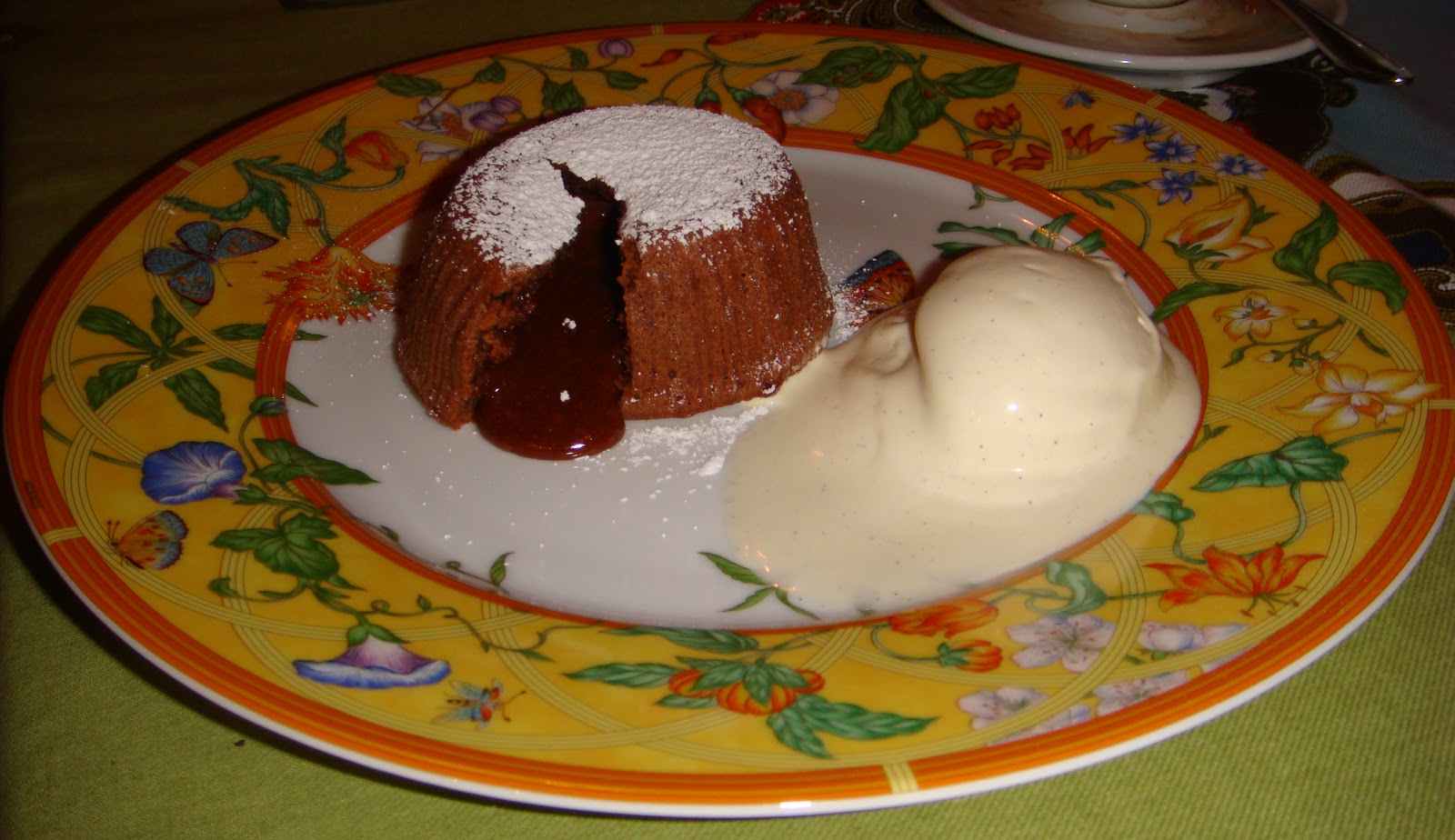
Warm Valrhona Chocolate Cake
with Vanilla Bean Ice Cream


A five-course French meal typically starts with an appetizer or soup, a fish course, sorbet, a meat course, a salad/cheese course, and dessert.

The Appetizer – Tuna Tartar

For this dish, sashimi grade tuna is sprinkled with a mixture of sugar and salt and cured overnight on racks in the refrigerator.  The tuna is then diced and mixed with green onion, capers, pickled ginger, mayonnaise, sesame oil, and Asian hot sauce.  


When plated, the tartar is topped with seaweed salad and served.


The Fish Course – Fish en Papillote with Beurre Blanc

Fish cooked in paper is very traditional and there are many forms of this dish.  For this dish one must do a lot of preparation prior to assembly.  First is the making of “snail butter.”  No, this is not butter made from the milking of snails.  Rather it is a compound butter made with parsley, shallots and garlic, and traditionally used to make escargot.


Next comes the julienne of peppers, carrot, leek, and celery, which are sautéed until soft.

Prominent in this picture is a mandoline.  This kitchen implement is basically a large razor blade used to cut items thinly and uniformly.  The one shown is a not very expensive one from Japan, but I also own an all stainless steal mandoline from France.  A word of caution here, if you do not pay very close attention when using a mandoline you will quickly find that it is one of the most dangerous kitchen tools in your cooking arsenal.

Everything is gathered for the construction of this dish.


Parchment paper forms are made, the fish and vegetable are placed inside along with some snail butter, and the package is folded and sealed.  


Once baked, they are cut open at the table and some beurre blanc is added. 


Beurre blanc is a French butter sauce made by the reduction of white wine and vinegar with the addition of shallots and bay leaf.  Once reduced, one-half pound of butter is slowly whisked in forming a thick emulsion.  When poured over the baked fish (remember, you can’t have too much butter), the combination is wonderful.


Sorbet –

Many people think of sorbet as a dessert.  In this application it is a pallet cleanser.  Here, a small portion of blueberry sorbet is served with Stoli Blueberi Vodka from Russia. 

Now a word about the making of the sorbet.  I am fortunate to own a Pacojet.  This is a device made in Switzerland that takes frozen products and turns them into the creamiest and smoothest sorbets and ice creams.  Prior to dinner, blueberries from the summer that were flash frozen are placed in a Pacojet container, simple syrup is added and the mixture is frozen. 


When “Pacotized” the result truly tastes like fresh blueberries.


The Meat Course – Blanquette de Veau à L’Ancienne

To me, this veal stew in a white sauce typifies everything that makes French cooking wonderful.  What seems to be a simple dish to the diner, the chef knows has taken some time for everything to come together perfectly.  In this dish, cubes of veal are slowly cooked until very tender.  Added are garnishes of sautéed mushrooms, pearl onions, and carrots.  The dish is served over rice and covered with a creamy ethereal sauce. 

This sauce is technically a velouté.  People are typically more familiar with a béchemel sauce, which is created by adding milk to a roux.  Béchemel is the basis of many creamy dishes ranging from mac and cheese to soufflés.  When a reduced and flavorful stock, such as chicken, beef, or in this case veal is added to the roux you have a velouté.  For this dish, the veal velouté is enriched with the addition of cream and egg yolks, and brightened with some freshly squeezed lemon juice.

Like so many wonderful French dishes this one fulfills the Murphy’s Law that states “That which takes the longest to prepare, takes the shortest to eat.”


The Salad and Cheese Course

For this dish an array of organic greens are dressed with a vinaigrette made with shallots, French mustard, vinegar, and oil.  The salad also has a julienne of red pepper, thinly sliced radishes that are also julienned, and little tomatoes that are halved.

We like to expose some of our guests to foods that they may not have had before.  Here we selected three French cheeses: Morbier, a cow’s milk cheese, Bucheron a goat cheese, and P’Tit Basque a cheese made of sheep’s milk.


Dessert -Warm Valrhona Chocolate Cake with Vanilla Bean Ice Cream

There are many recipes for “molten chocolate cake.”  However, for me they break into two distinct categories, real and not so real.  The “real deal” is a cake that is baked to the point of the outside solidifying just enough to hold together when plated, yet when pierced the uncooked batter flows out.  The not so real cake is what most people experience in most restaurants throughout the United States.  This form of the desert is made by freezing and inserting a ball of ganache into the middle of the batter and baking it.  When cut, the melted ganache flows out onto the plate.  The reason that the real cake is hard to come by is two-fold.  First, the timing must be precise within seconds, a few too many and you have a solid cake, a few too little and you have a pool of chocolate soup.  Secondly, the real cake flows with undercooked batter, thus potentially undercooked eggs.  I always like to live a little dangerously when I cook for friends.


This dessert is served with a French custard vanilla ice cream that is made with Tahitian vanilla beans.  Once again the Pacojet is called into service to take the frozen custard, sans ice cream maker, and produce an incredibly smooth vanilla ice cream.


This dinner, like many that we do, typically leaves our guests either totally quiet or emitting soft pleasant groans of satisfaction.  However, this meal attained the highest possible compliment, Paul sobbing at the table.